Love this. Wish I had unlimited time to do these.
Monday, December 12, 2011


Tuesday, November 15, 2011
Helping and staying out of the way
Inspired by some great talks at Tedx at Macquarie university in October, I have started to explore options for helping people without getting in their way. The focus of this for me is doing things that empower people to make their own decisions, rather than being disempowered. Related to this is an idea that I'm embarrased to say i only hear about earlier in the year: seeing the person in need as the person who is an expert in what they need. This idea of recognizing the experience of those we want to help is actually something we talk about a lot in therapies. Most modern therapies acknowledge that the client is actually a wealth of important information about how to help themselves; the therapist is often seen as a facilitator or guide who can help you discover new tools, but itsn't necessarily there to be the expert. I'm always surprised how many people start their first session thinking that the therapist will be the main speaker during sessions, that the therapists knowledge will rule supreme. When I explain to people that I consider them important experts, the reactions on their faces are mostly relief, surprise, and often, pride. So I probably should have thought of this approach long before the speakers at Tedx MacU helped me see the light. My adventures in this area are new, but here are my initial discoveries. these ideas have made it onto my christams shopping list for my family! KIVA.COM http://www.kiva.org/about Microfinancing to help individuals in developing regions (you loan a small amount of $ to a person who wants to start their own business or venture but who doesn't have the capital to see start up themselves. They pay it back to you in managable installments once their venture is off the ground. PROJECT FUTUTRES INTERNATIONAL AND AUSTRALIA http://projectfutures.com/ Project futures, in partnership with the Somlay Mam Foundation, sell products to support the rescue of children and women from sex trafficking. The silk beads are my favorite and they are made by some of the women themselves! Somlay Mam makes sure that women are given business classes and sewing/ craft classes so that they have viable occupational opportunities to support themselves. What do you think? Who else is doing good work? I haven't done all my Christmas shopping, so I'd love to hear your ideas.
Thursday, October 6, 2011
I went to the Australian Psychological Society's 2011 conference and this is what I saw...
I am tired to my core but very happy with the week I've had. I want to write more completely about it, but here are some of the highlights, for now:
Presenting with James Cook University and Griffith University about our survey of first year psychology students' expectations.
Reporting some evaluative data from my first year professional unit (you can see the slides below).

A mindfulness workshop with the wonderful Bob Rich
Learning that there are other psychologists who also think that there is opportunity for us to volunteer and make a difference in our communities
Hearing more from the lovely Lynne Cohen (ECU) about her leadership program - our psychology students at QUT participated this year and it was a fantastic experience.
Learning about Kelly Brownell's (Yale Rudd Center for Health) view of obesity and how psychologists can make a difference not through individual interventions but via social and political change.
Seeing Les Posen present...his work makes me feel ashamed of my presentations but hopeful that I can be reformed. His descriptions of how to introduce clients to exposure-based approaches to anxiety was inspiring and I wish everyone at the Higher Education sessions had also come to his presentation!
There's so much more I could write but I'll save it for a less sleep-deprived moment.
Oh and I have been selected as one of the 100 lucky people who were invited to attend the TEDx event in Sydney on the 16th of October. Very exciting.
Tuesday, August 30, 2011
"Looking for tears? Not going to happen." Making the most of things.
I'm a runner.

I'm a runner, but a latecomer to the sport. I was never sporty as a child, it is all new to me, so that makes me a huge fan of everyone that runs well. I can be caught grinning like an idiot at the gazelle-like folk who effortlessly stride around at the track sessions at my running club (OK, I've only been to one session so far but there were gazelles, I swear). I'm not jealous, not frustrated, by their amazing talent...I'm just in awe and so happy to see them.
Anyway, all this running and crazy grinning means that means that I've been staying up each night to see the highlights of the World Athletics Championship. I'm really enjoying the event and I was like a kid on Christmas eve on the night of the 100 meters men's final. I had this amazing feeling that Usain Bolt was going to set the world on fire. What do I know? Clearly, I'm an uninformed idiot.
If you're not into sport or you've been out of touch with society for a while, here's what happened:
The thing that has stuck with me...apart from the embarrasing sulky feeling I felt for the rest of the evening...is the response from Bolt. He is rumoured to have said to Blake, his training partner (and subsequent winner of the race) "Looking for tears? Not going to happen. I'm OK.". I'm not sure how we get from this quote to "furious" but that's how the UK newspaper the mirror reported it (see here) maybe they just assumed that's how he'd feel. He looked dissappointed and very unhappy for a while, but furious? I think they just reported the story they wanted to. In other papers, we see different quotes from Bolt:
On the 29th of August, Bolt's website released this statement “Firstly I would like to congratulate my team mate Yohan Blake and the other athletes who won the medals.
Of course I am extremely disappointed not to have had the chance to defend my title due to the false start. I was feeling great through the rounds and was ready to run fast in the final. I worked very hard to get ready for this Championships and things were looking good.
However I have to move on now as there is no point to dwell on the past. I have a few days to refocus and get ready for the 200m on Friday. After this I have the 4x100m and a few other races before the end of the season. I know that I am now in good shape and will focus on running well in the 200m.
Thanks to all the people who sent me good wishes and I will try my best to make you proud in the 200m.” you can read it here: http://www.usainbolt.com/article/48
I think Bolt made some good choices with the statements he made. Also, they seem to walk the fine line between two concepts that interest me at the moment - both of which are important in psychology and one of which is the focus of a lot of attention in higher ed and training at the moment: reflection and mindfulness.
Reflection
Reflection is something we all do, to some extent, but many of us do it poorly and don't get the full benefit from our effort. Reflection is part of the adult learning process and involves reviewing our actions, learning, emotions, cognitions, and the results of outcomes of these actions. Surface level reflection might just involve us noticing that something has happened or that we've had a certain thought. You might notice that a friend seemed distant in conversation, or that a family member seemed to respond unexpectidly to your latest news. Deeper reflection involves drawing links between our current and past experiences; considering the meaning or reasons for patterns in our behaviours, thoughts or emotions; evaluating where we are going well, where we can improve and why; and some form of restructuring or developing plans for the future. That's my idea of reflection in a nutshell.

I believe reflection is what gives some adults the edge over others. Knowing when and how to reflect and developing the best plans out of reflection can be of great benefit for super gazelles like Bolt, but also for regular plodders like me. I believe reflection can be used in our professional lifes, in our relationships, and in the areas of life in between. Certainly, Bolt can probably benefit from delaying further reflection on this race - especially as he prepares for his next event - but his statements do indicate some level of review, evaluation of the outcome, and plans to move forward in the championships.
There's a whole range of models to help guide reflection and to describe where reflection fits in adult learning processes. There's also many other ways to describe reflection - maybe someone will correct my description. :) Nice little summaries have been posted here and here. I'm consious that many models actually just show us where researchers think reflection happens in the adult learning process. They don't help guide us through a process of how to reflect. Often, when trying to do consious reflections for the first time, we need some help with the steps or process, rather than ideas about when this happens in the learning process. The model I've been using is the 4R model and you can read a description here. I've trialled it with some 3rd year and 1st year cohorts and it seems to be fairly useful in guiding people through the process of academic and professional reflections. Although I'm still a little concerned that it focuses a lot on critical incidents and problems, it has worked well (any ideas for helping students reflect on what they are doing well would be most appreciated!).
Mindfulness
The concept that Bolt's quotes reminded me of was mindfulness. Mindfulness is often linked with Buhdisim but it has historical origins that are far broader and go further back in time. Looking at some of the modern mindfullness, we can think of mindfulness as an ability to be in the present moment: attentive, aleart, and focused. In his statement, he refocuses on the task at hand and preparing for his next race. Watching the athletes perform this week, espcially in the sprints and also in the events like javlin and high jump, you can see that they are focused on the moment. Much of sport psychology is based around focusing on each point, each stage of an event, without letting a mistake at any moment distract you for too long.

What does this mean for us mere mortals? How does mindfulness translate to everyday life? Mindfulness aims to help people live their life fully. To listen 100% when a loved one asks for your ear. To focus on each moment - to identify and take things in when you feel uncomfortable, when you're happy, when you're relaxed. To appreciate the good and notice, without getting too caught up in the bad. You can find some more information about mindfulness and some basic activities here. Mindfulness is also used in psychology and is a major component of ACT (acceptance and commitment therapy). You can find out more about mindfulness and therapy here.
To some, it might sound like these to concepts, mindfulness and reflection, are polar opposites of one another. However, I tend to believe that things are more complicated than that. Call it the old "two sides of the same coin" trick but I think that without mindfulness, reflection is often clouded by hindsight bias. We reflect back, knowing how things turned out and start to believe things about our motivations or insight that simply wasn't the case at the time. Further, without reflection, mindfulness doesn't reach its full potential...it doesn't give us the deepest understanding that it is capable of.
This is something I'm exploring more with my teaching and my research. I'd love to know what other people think - is this too airy fairy for you or does it strike a chord?
Reflecting back, Bolt's false start is something I'll remember for a long time but I'm mindful that there's more athletics to watch tonight :)
Monday, August 22, 2011
Journey into online scenarios - Part 2
Ok so here's the second video. It shows you how to take your wonderful linked up powerpoints and turn it into an online module:
Now, just like Spiderman's uncle said (kidding!) "with great power comes great responsibility". You need to use these modules to create great learning experiences. The version I've used in the demonstration videos is pretty basic and doesn't do this well but here's some of the key aspects:
- Don't just use the powerpoint headings and bulletpoints - zzzzz!
- Create a story that is quirky, interesting, or will appeal to your audience
- The story has to create the need for the learning. It should illustrate why your learner is going to bother to do the activity"give them a burning for learning" (sorry, I couldn't help myself).
- Spend some time thinking about the look and useability. Often, university lecturers outside of design or the creative industries forget how important this is. I'm just as guilty as anyone, but I'm trying to get better.
Hopefully, what you end up with is engaging for the learner, works well to develop the learner towards the intended learning outcomes, and adds a bit of spark to your units.
Enjoy!
Friday, July 29, 2011
Prezi vs. PowerPoint: Why I'll never pick a side
Just as an aside to my posts about online learning, I wanted to add my 2 cents worth to the prezi vs powerpoint debate. Obviously, there are many people who are sick to death of boring horrible PowerPoint presentations. Sometimes I think that if I see any more versions of that stock standard title and bullet points slide I might puke. However, I'm not ready to completely dismiss PowerPoint like these folk:http://prezi.com/wwmfvms6dno-/death-of-powerpoint-prezihelpcom/ or the Anti PowerPoint Party in Switzerland, a group who would love for us all to give up PowerPoint for good (OK, I'm exagerating! The 'leader' is just asking us to consider our use.): http://www.anti-powerpoint-party.com/en
Prezi is really exciting and a bit of a revelation the first time you see it. Prezi allows much better integration of pictures, organisational diagrams, and video than PowerPoint has ever allowed. Prezi looks clean and the fonts and options for formatting encourage that nice balance of clean lines and white space that appeal to us all.
I really enjoy showing students prezi for the first time. Their reactions are wonderful. I think using different techniques for different classes also shows students that your thinking about them and that you want to keep thing fresh. Here's my own go at presenting the week 1 class of my first year psychology class through Prezi: http://prezi.com/aptydeva0mev/welcome-to-psychology/

If you're a learning designer or curriculum consultant, feel free to borrow my prezi for "think pair share". You can find it here: http://prezi.com/gexbogc_ymt8/think-pair-share/
As much as I like Prezi, there are some advantages to keeping PowerPoint in your toolkit.
First, I don't own the professional version of Prezi, so uploading pictures and files can slow down my production time in Prezi. I also am required to generate notes from my students for every class. Prezi doesn't generate notes for your audience; at least, I haven't discovered a way to do it. Prezi also is a little frustrating when presented on different sized screens and via some projectors and I've found that Prezi takes a little longer to construct.
For me, PowerPoint is not just a presentation tool. PowerPoint also is useful for planning out websites and creating posters (just change the page settings to A0 or whaterver size you need). PowerPoint is a reasonable image editing tool and the 2010 version has some fantastic functions to create transperant space around your images. Tom Kuhlman is an absolute rock star of learning design and his posts are excellent tutorials about how to use PowerPoint and similar tools to their full potential. See Tom's PowerPoint blogs here http://learningppt.com/ and here http://www.articulate.com/rapid-elearning/ Also, if you are willing to ditch the stock standard layouts in PowerPoint, I think you can make pretty great presentation.
I'd love to hear about your attempts with Prezi, what do you like about Prezi? What you don't like? Will you ever succumb to the APPP's cry and give up PowerPoint for good?
Prezi is really exciting and a bit of a revelation the first time you see it. Prezi allows much better integration of pictures, organisational diagrams, and video than PowerPoint has ever allowed. Prezi looks clean and the fonts and options for formatting encourage that nice balance of clean lines and white space that appeal to us all.
I really enjoy showing students prezi for the first time. Their reactions are wonderful. I think using different techniques for different classes also shows students that your thinking about them and that you want to keep thing fresh. Here's my own go at presenting the week 1 class of my first year psychology class through Prezi: http://prezi.com/aptydeva0mev/welcome-to-psychology/
As much as I like Prezi, there are some advantages to keeping PowerPoint in your toolkit.
First, I don't own the professional version of Prezi, so uploading pictures and files can slow down my production time in Prezi. I also am required to generate notes from my students for every class. Prezi doesn't generate notes for your audience; at least, I haven't discovered a way to do it. Prezi also is a little frustrating when presented on different sized screens and via some projectors and I've found that Prezi takes a little longer to construct.
For me, PowerPoint is not just a presentation tool. PowerPoint also is useful for planning out websites and creating posters (just change the page settings to A0 or whaterver size you need). PowerPoint is a reasonable image editing tool and the 2010 version has some fantastic functions to create transperant space around your images. Tom Kuhlman is an absolute rock star of learning design and his posts are excellent tutorials about how to use PowerPoint and similar tools to their full potential. See Tom's PowerPoint blogs here http://learningppt.com/ and here http://www.articulate.com/rapid-elearning/ Also, if you are willing to ditch the stock standard layouts in PowerPoint, I think you can make pretty great presentation.
I'd love to hear about your attempts with Prezi, what do you like about Prezi? What you don't like? Will you ever succumb to the APPP's cry and give up PowerPoint for good?
Friday, June 24, 2011
My journey into online scenarios - Part 1
I don't know anyone who teaches psychology who doesn't care a whole lot about their students. It is such a great community to be a part of. I really like teaching psychology and meeting people who teach psych too.
The biggest lesson for me over the last 6 months has been how much I didn't know about online learning and teaching. It is amazing! I started with a real curiosity around image maps (see this explanation). Why did some people have engaging amazing moodle or blackboard sites and I didn't? I'm really into teaching, why hadn't I found a way to do those cool sites?? Was there are a secret that the learning support people didn't want me to know? The most impressive thing I'd done was a few Prezi presentations. Check out this serious example I made and a fun example if you haven't discovered Prezi yet :)
I learnt about image maps, and they are nice and pretty but they don't really do anything specifically for the learner unless you are really careful in your design. More importantly, they don't get the learner to do anything. So I made another discovery, helped in a very big way by the learning designer for my department. He gets to spend one day a week with our faculty (which is the name for a group of departments here) and so I'd never actually met him...because he's a busy guy and has to try to get around to a whole bunch of schools in just one day. He showed me this online activity and it completely changed my ideas about online learning.
Go on, do the activity....at least give it a minute! The activity was created by Cathy Moore and you can read her blog here.
It gave me a thirst for more scenario knowledge! Here's what I learnt:
1. PowerPoint is actually fantastic
There's a lot of PowerPoint haters out there but I learnt that with PowerPoint and a little know how anyone can make online scenarios. PowerPoint is an amazing tool! I started to learn how to hyperlink pages of a presentation together and how to save so my students had to work through the challenges I'd set up for them. It was a revelation!
2. People are generous and The Rapid E-Learning Blog is a wonder
I started to learn more skills and options by reading up on PowerPoint and online scenarios at the Rapid E-Learning Blog. (image below is from blog and is not mine!)
 You could start anywhere on this blog and get some excellent ideas, free templates, and very helpful tutorials. I really like this post.
Then I learnt my next lesson.
3. The quality and design of free tools in the e-Learning sector is outstanding
I am not a podcaster...there, I said it. I hate just listening to audio and always prefer to have the option of visuals, even if I don't watch the screen all the time. I find podcasts boring to make and, unless the presenter is truly excellent, I find podcasts horrible to listen to. The I found screenr.com and I fell in love. 5 mins max, screen casting (that means making a video of your computer screen content...I had no idea what a screencast was!).

I used screenr (image above is owned by screenr) to make some 'refresher' videos for people who are learning how to make these online scenarios. You can watch part 1 here.
The biggest lesson for me over the last 6 months has been how much I didn't know about online learning and teaching. It is amazing! I started with a real curiosity around image maps (see this explanation). Why did some people have engaging amazing moodle or blackboard sites and I didn't? I'm really into teaching, why hadn't I found a way to do those cool sites?? Was there are a secret that the learning support people didn't want me to know? The most impressive thing I'd done was a few Prezi presentations. Check out this serious example I made and a fun example if you haven't discovered Prezi yet :)
I learnt about image maps, and they are nice and pretty but they don't really do anything specifically for the learner unless you are really careful in your design. More importantly, they don't get the learner to do anything. So I made another discovery, helped in a very big way by the learning designer for my department. He gets to spend one day a week with our faculty (which is the name for a group of departments here) and so I'd never actually met him...because he's a busy guy and has to try to get around to a whole bunch of schools in just one day. He showed me this online activity and it completely changed my ideas about online learning.
Go on, do the activity....at least give it a minute! The activity was created by Cathy Moore and you can read her blog here.
It gave me a thirst for more scenario knowledge! Here's what I learnt:
1. PowerPoint is actually fantastic
There's a lot of PowerPoint haters out there but I learnt that with PowerPoint and a little know how anyone can make online scenarios. PowerPoint is an amazing tool! I started to learn how to hyperlink pages of a presentation together and how to save so my students had to work through the challenges I'd set up for them. It was a revelation!
2. People are generous and The Rapid E-Learning Blog is a wonder
I started to learn more skills and options by reading up on PowerPoint and online scenarios at the Rapid E-Learning Blog. (image below is from blog and is not mine!)
Then I learnt my next lesson.
3. The quality and design of free tools in the e-Learning sector is outstanding
I am not a podcaster...there, I said it. I hate just listening to audio and always prefer to have the option of visuals, even if I don't watch the screen all the time. I find podcasts boring to make and, unless the presenter is truly excellent, I find podcasts horrible to listen to. The I found screenr.com and I fell in love. 5 mins max, screen casting (that means making a video of your computer screen content...I had no idea what a screencast was!).
I used screenr (image above is owned by screenr) to make some 'refresher' videos for people who are learning how to make these online scenarios. You can watch part 1 here.
Monday, May 23, 2011
Abandoned Minds: Social Justice, Civil Rights and Mental Health – Part 1 | World of Psychology
After listening to a lecture about ethics and rights in research, this blog entry by Daniel Tomasulo seemed to important to pass up. Not about research this time but about how we treat people in mental health contexts - especially if they have difficulty consenting due to intellectual disability or other reasons. An issue that I'm sure will create a lot of debate:
Tuesday, May 17, 2011
Great psychology games
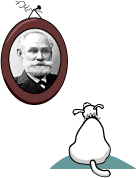
I love tools that make learning interactive and fun. The Nobel Prize website has some great resources. I'm a bit fan of this one: Pavlov's dog. Try it out for yourself!

I must admit to being a Pavlov groupie - there are records of the lengths that Pavlov went to ensure his animals were well cared for. He even used his own personal income towards their care and moved his lab so that the animals would have open spaces to run/play. Pavlov and his wife also set agreements early in their marriage about their lifestyle. She agreed to run the household and support him to conduct his research if he would refrain from drinking and excessive socialising. He is often criticized these days but I think he was doing his best with what he had.
I hope to make some modules and games for other psychology topics soon!
Image owned by Nobel Prize and created by Lotta Fredholm: "Pavlov's Dog". Nobelprize.org. 18 May 2011 http://nobelprize.org/educational/medicine/pavlov/readmore.html
I must admit to being a Pavlov groupie - there are records of the lengths that Pavlov went to ensure his animals were well cared for. He even used his own personal income towards their care and moved his lab so that the animals would have open spaces to run/play. Pavlov and his wife also set agreements early in their marriage about their lifestyle. She agreed to run the household and support him to conduct his research if he would refrain from drinking and excessive socialising. He is often criticized these days but I think he was doing his best with what he had.
I hope to make some modules and games for other psychology topics soon!
Image owned by Nobel Prize and created by Lotta Fredholm: "Pavlov's Dog". Nobelprize.org. 18 May 2011 http://nobelprize.org/educational/medicine/pavlov/readmore.html
Wednesday, March 30, 2011
Sunday, March 13, 2011
On the search for a great psychology comic :)
I loved PhD comics when I was studying, they offered hours of reassurance and a quirky look at how post graduate study is different to undergraduate study.
And lab scientists have this one and this one. Where's the psychology comic?
So, I'm on the hunt for a great psychology comic. I've found these ones from Mark Parisi: http://www.offthemark.com/psych.htm but would love to find a comic strip that has regular characters and a bit more of a story line.
Any suggestions?
And lab scientists have this one and this one. Where's the psychology comic?
So, I'm on the hunt for a great psychology comic. I've found these ones from Mark Parisi: http://www.offthemark.com/psych.htm but would love to find a comic strip that has regular characters and a bit more of a story line.
Any suggestions?
Thursday, February 10, 2011
Best of psychology on the web - 1
Starting up this blog is helping me make sure that I regularly search for psychology related material. I'm getting much better at going through all the news sources and journals.
In this post, I'm still in a silly mood. So instead of a serious post, here's a collection of the most intriguing psychology stuff I've found on the web. Enjoy!
Need a gift for that friendly neighbourhood psychologist? Look no further, this site has all your psych gift needs wrapped up.
Starting a psychology degree and want to get a quick handle on the top 100 important 'ideas'? The What Makes them Click blog has created a list of 100 things you should know about people. Great way to present things!
Dan Ariely's (author of predictably irrational) maintains a blog that is a great combination of his personal stories with behavioural economics and consumer psychology. He's got a knack for designing really nifty studies.
And a final one: Check out Psychology Today's list of studies published in 2010 that you should know about. I really like their number 10 which studied procrastination in students. Turns out "If you want to get yourself out of the procrastination trap, stop beating yourself up and try a little selfforgiveness instead".
In this post, I'm still in a silly mood. So instead of a serious post, here's a collection of the most intriguing psychology stuff I've found on the web. Enjoy!
Need a gift for that friendly neighbourhood psychologist? Look no further, this site has all your psych gift needs wrapped up.
Starting a psychology degree and want to get a quick handle on the top 100 important 'ideas'? The What Makes them Click blog has created a list of 100 things you should know about people. Great way to present things!
Dan Ariely's (author of predictably irrational) maintains a blog that is a great combination of his personal stories with behavioural economics and consumer psychology. He's got a knack for designing really nifty studies.
And a final one: Check out Psychology Today's list of studies published in 2010 that you should know about. I really like their number 10 which studied procrastination in students. Turns out "If you want to get yourself out of the procrastination trap, stop beating yourself up and try a little selfforgiveness instead".
Tuesday, February 8, 2011
A bit fun, a bit serious
I really like the idea behind psychwiki this wiki is an attempt to explain core concepts of psychology. It isn't finished yet, but is a great idea. Check it out!
Also, just for fun, some psychology songs to get you in the mood for the start of the Australian semester (sorry folks in other countries...this is a bit late for you!)
Here's one to think about - what is the difference between a psychiatrist and a psychologist in general and in your country?
Also, just for fun, some psychology songs to get you in the mood for the start of the Australian semester (sorry folks in other countries...this is a bit late for you!)
"Crazy" - Gnarls Barkley. When I hear this song, makes me think about people's own stories about their mental health care and the experience of receiving a mental health diagnosis. Beyondblue has a great site that records people's experiences with depression and anxiety.
"Djapana" - Yothu Yindi reminds me that often in Australia we only learn about western traditions of psychology. Psychology is much more than that. The Australian Indigenous Psychology Association is a great place to start if you want to learn more. Also, when I hear this song, I think about the experience of homesickness and acculturation. Even though these terms are used in psychology to demonstrate different things, the terms both incorporate a feeling that your real home is far far away.
"Runaway train" - Soul Asylum
Speaking of 'home' Soul Asylum's song reminds us of the experiences of homelessness and the many complex factors involved in someone becoming homeless. For an Australian perspective on children who are homeless, see this fact sheet.
Here's one to think about - what is the difference between a psychiatrist and a psychologist in general and in your country?
"Frontier Psychiatrist" - The Avalanches
What is your favourite song about psychology?
Sunday, February 6, 2011
How to get the 'low-down' on psychology
I really love thinking about the implications of news stories, particularly for psychology. Sometimes, a news story that I'm listening to will confirm some of the more stable 'findings' of psychological research. Other times, I'll find myself thinking of new research projects inspired by the regular news.
Here's a list of my favourite psychology new websites:
Science Daily has a psychology site:
http://www.sciencedaily.com/news/mind_brain/psychology/
Psychology Today, the magazine, has an online site which publishes many stories in full, and some blogs too. I think it is a great place to start reading about psychology because the stories incorporate a lot of explanations of foundational concepts and they seem to cover broad, engaging topics:
http://www.psychologytoday.com/
The American Psychological Association has their own site for news stories - mostly from USA media outlets.:
http://www.apa.org/news/psycport/index.aspx
Alltop's psychology page is another great starting place, the site is basically a 'net' for collecting psychology news from around the web. Some links will take you to media outlets and others will send you to blogs & wikis:
http://psychology.alltop.com/
Here's a list of my favourite psychology new websites:
Science Daily has a psychology site:
http://www.sciencedaily.com/news/mind_brain/psychology/
Psychology Today, the magazine, has an online site which publishes many stories in full, and some blogs too. I think it is a great place to start reading about psychology because the stories incorporate a lot of explanations of foundational concepts and they seem to cover broad, engaging topics:
http://www.psychologytoday.com/
The American Psychological Association has their own site for news stories - mostly from USA media outlets.:
http://www.apa.org/news/psycport/index.aspx
Alltop's psychology page is another great starting place, the site is basically a 'net' for collecting psychology news from around the web. Some links will take you to media outlets and others will send you to blogs & wikis:
http://psychology.alltop.com/
Tuesday, January 25, 2011
ECT’s Final Days?
There are a few things I really love discussing with students...mostly because of their fresh perspective on old topics in psychology and partly because they have a great way of cutting through the BS that gets built up around older ideas.
ECT - electro-convulsive therapy, is one of those topics. I find it particularly reassuring that each time I explain that yes, we are talking about administering electricity directly to the brain, I'm met with looks of horror and shock (no pun intended...okay, maybe a little pun). When I get that reaction, I know that there is still some good in the world *phew*. I think it is perfectly normal to react this way when you first hear about ECT.
If you're interested in the topic, you should duck over to the PsychCentral blog. JOHN M GROHOL reports on a FDA investigation into how ECT is classified in the United States. If you read through this entry you'll get a very interesting (and potentially upsetting) insight into how business, profits and health services can collide.
I wonder what minimum standards of evidence you would want if it was your brain receiving ECT? How would you like to see a professional body (like the APA, who made this statement) involved? Although psychologists in Australia are not responsible for administering ECT, as a treatment that is still used and accepted in the treatment of mental health, this is an issue worth discussing.
ECT - electro-convulsive therapy, is one of those topics. I find it particularly reassuring that each time I explain that yes, we are talking about administering electricity directly to the brain, I'm met with looks of horror and shock (no pun intended...okay, maybe a little pun). When I get that reaction, I know that there is still some good in the world *phew*. I think it is perfectly normal to react this way when you first hear about ECT.
If you're interested in the topic, you should duck over to the PsychCentral blog. JOHN M GROHOL reports on a FDA investigation into how ECT is classified in the United States. If you read through this entry you'll get a very interesting (and potentially upsetting) insight into how business, profits and health services can collide.
I wonder what minimum standards of evidence you would want if it was your brain receiving ECT? How would you like to see a professional body (like the APA, who made this statement) involved? Although psychologists in Australia are not responsible for administering ECT, as a treatment that is still used and accepted in the treatment of mental health, this is an issue worth discussing.
Thursday, January 20, 2011
What are you really learning?
Ok, so it is the start of the academic year in Australia, so I probably shouldn't be this cynical yet. I just happen to think that it is important to really think about what students are really learning and what teachers are really doing. A recent Chronicle of Higher Ed article
The authors reported that:
"While higher education is expected to accomplish many tasks—and contemporary colleges and universities have indeed contributed to society in ways as diverse as producing pharmaceutical patents as well as prime-time athletic games—existing organizational cultures and practices too often do not put a high priority on undergraduate learning. Faculty and administrators, working to meet multiple and at times competing demands, too rarely focus on either improving instruction or demonstrating gains in student learning."
These questions aren't new. Event the comedian Father Guido has had a go at universities for being ineffective:
While I think I certainly gained more from my education than you might in Guido's 5 minute university, I do wonder why we keep piling on the content. We know that no one will remember all that detail 2 days after the final exam but we keep doing it. I know that the things I learnt and remembered were taught in interactive classes, with case studies or examples. AND they weren't those awful forced, boring case studies. They were interesting and got me thinking why I was really studying psychology. These activities made me stop and think about the fact that someday, I would be applying these skills and someone's education, happiness, or health would depend on me doing a good job.
When universities are being pressured to focus more and more on research, what can be done to ensure teaching quality? I'm not suggesting that research isn't important. It is. So much of our society progresses because there are passionate scientists and researchers using their amazing analytical and creative skills to cure disease, explore frontiers of knowledge, and innovate beyond boundaries. I just think that there is no future for research or any other profession if we aren't prioritizing teaching.
I wonder what kind of staffing models we should have for Higher education. What would happen if we allowed some academics/faculty to nominate research as their main interest and lightened their teaching load? What if we allowed academics who want to teach to pick up more classes and lighten their research load? Would we be making the most of people's passions? Or would this be a recipe for disaster?
The authors reported that:
"While higher education is expected to accomplish many tasks—and contemporary colleges and universities have indeed contributed to society in ways as diverse as producing pharmaceutical patents as well as prime-time athletic games—existing organizational cultures and practices too often do not put a high priority on undergraduate learning. Faculty and administrators, working to meet multiple and at times competing demands, too rarely focus on either improving instruction or demonstrating gains in student learning."
"More troubling still, the limited learning we have observed in terms of the absence of growth in CLA performance is largely consistent with the accounts of many students, who report that they spend increasing numbers of hours on nonacademic activities, including working, rather than on studying. They enroll in courses that do not require substantial reading or writing assignments; they interact with their professors outside of classrooms rarely, if ever; and they define and understand their college experiences as being focused more on social than on academic development."
- Richard Arum and Josipa Roksa, 18 Jan, 2011
These questions aren't new. Event the comedian Father Guido has had a go at universities for being ineffective:
While I think I certainly gained more from my education than you might in Guido's 5 minute university, I do wonder why we keep piling on the content. We know that no one will remember all that detail 2 days after the final exam but we keep doing it. I know that the things I learnt and remembered were taught in interactive classes, with case studies or examples. AND they weren't those awful forced, boring case studies. They were interesting and got me thinking why I was really studying psychology. These activities made me stop and think about the fact that someday, I would be applying these skills and someone's education, happiness, or health would depend on me doing a good job.
When universities are being pressured to focus more and more on research, what can be done to ensure teaching quality? I'm not suggesting that research isn't important. It is. So much of our society progresses because there are passionate scientists and researchers using their amazing analytical and creative skills to cure disease, explore frontiers of knowledge, and innovate beyond boundaries. I just think that there is no future for research or any other profession if we aren't prioritizing teaching.
I wonder what kind of staffing models we should have for Higher education. What would happen if we allowed some academics/faculty to nominate research as their main interest and lightened their teaching load? What if we allowed academics who want to teach to pick up more classes and lighten their research load? Would we be making the most of people's passions? Or would this be a recipe for disaster?
Wednesday, January 5, 2011
Getting started in psychology - Part 1
Hi there,
This is a quick post to anyone interested in starting a course in Psychology. When you are thinking about starting study, it is important to make sure that you are informed about a few things like:
This is a quick post to anyone interested in starting a course in Psychology. When you are thinking about starting study, it is important to make sure that you are informed about a few things like:
- What the course will require. How many hours a week will you be expected to study? What types of things will you be studying...do you really know what the topic is about? Will you have to travel? What expenses are you likely to encounter including course fees, study materials, and other costs?
- What does this course prepare you for? It helps to have a very clear idea about what careers the course leads to and what types of salary and working conditions you should expect. Also, in most countries, a Bachelor's degree is only the first step of many to becoming a Psychologist. If your goal is to be a registered Psychologist, make sure you know how many years of training and the full cost of this career goal will be.
- Are the skills and knowledge you'll gain transferable and do they suit your interests? Many people explore more than one career path over their lifetime. Spend some time finding out about the skills that you might gain in this course that could be useful if you decide to get creative with your career. For example, if you study Psychology you could become a Psychologist but you might also become an advertising executive, a social researcher, a life coach, a disability support worker, an audiologist...there are a lot of possibilities!
- Will this study really fit your lifestyle? Study will take time and commitment. Make sure you take a good look at your current responsibilities and work out how study will fit into your existing life. Many people find that before taking on study, they need to reduce their commitment to something else in their life.
- The Australian Psychological Society: http://www.psychology.org.au/
- The Americal Psychological Association: http://www.apa.org/
- Psychology Today Magazine: http://www.psychologytoday.com/
- The Graduate Careers (Australia) report for Psychology: http://www.graduatecareers.com.au/CareerPlanningandResources/careerprofiles/Psychology/index.htm
Subscribe to:
Posts (Atom)